
Citizens Commission on Human Rights Seattle Opens Educational Exhibit to Packed Crowd
The eye-opening exhibit raises community awareness of mental health abuses all around us.
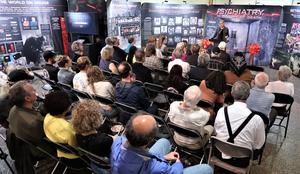
SEATTLE, WA, July 22, 2026 -- The Seattle chapter of the Citizens Commission on Human Rights (CCHR) officially opened its educational exhibit on July 17 before a packed audience of community members, advocates, and guests. The grand opening featured remarks from CCHR Seattle President Richard Warner and author, speaker and criminal justice reform advocate Ginny Burton, followed by a ribbon-cutting ceremony and public viewing of the exhibit.
The exhibit, in Seattle for a limited engagement, presents the history of mental health practices, information about patient rights and the importance of transparency in mental health care.
Richard Warner, President of CCHR Seattle, welcomed attendees and introduced the organization's mission as a nonprofit, non-political, non-religious mental health industry watchdog focused on exposing abuses committed under the guise of mental health and advocating for stronger patient protections.
Warner highlighted CCHR's more than 50 years of advocacy work, noting that the organization has chapters around the world and has supported legislative efforts that are designed to protect individuals from abusive and coercive mental health practices. He also discussed the Seattle chapter's involvement in monitoring legislation affecting Washington, Alaska, and Montana.
"As we sit in the middle of this exhibit, surrounded by decades of documented history, we must understand the mistakes and harms of the past so they are never repeated," Warner said. "By learning from history and working together, we can help build a better future."
During his remarks, Warner discussed CCHR's position that greater awareness is needed regarding psychiatric drug use, withdrawal experiences, and patient rights. "This exhibit exists because millions of Americans—nearly 77 million—are currently prescribed psychiatric drugs," Warner said. "Six million of those are children."
The evening's featured speaker, Ginny Burton, shared her personal story of addiction, incarceration, recovery, and transformation. Burton, author of The Gabriel Plan: Ten Points to Recover Our Nation, described how she overcame significant personal challenges, earned a Bachelor of Arts degree in Political Science from the University of Washington, and developed a program aimed at helping incarcerated individuals address the circumstances that contributed to their involvement with the justice system.
Burton spoke about the importance of personal responsibility, resilience, and recognizing one's own ability to change.
"I had a realization that the person who got me there was going to have to be the one who got me out," Burton said, describing the turning point that began her path to recovery.
Burton also shared her experiences with addiction, social services, and mental health systems, explaining how those experiences shaped her views and strengthened her commitment to helping others find pathways toward recovery and self-empowerment.
She encouraged attendees to review the information presented in the exhibit and to explore the documentation and resources available.
Following the speakers' remarks, guests participated in a ribbon-cutting ceremony officially opening the exhibit. Attendees then toured the displays, viewed historical materials, and spoke with event organizers and guests.
The Citizens Commission on Human Rights (CCHR) is a nonprofit organization founded to advocate for patient and consumer rights in the field of mental health. CCHR works through public education, awareness campaigns and legislative advocacy to address abuses and violations of human rights within mental health practices. It was co-founded by the Church of Scientology and Professor of Psychiatry Emeritus Dr. Thomas Szasz in 1969. Internationally, more than 100 independent CCHR offices in 34 countries continue to advocate for protecting individuals from psychiatric abuse.
For more information, visit the CCHR website, or watch documentaries on the work of CCHR volunteers in countries around the world and the film Psychiatry: An Industry of Death on the Scientology Network.
# # #
Contact Information
Steven PearceCitizens Commission on Human Rights Seattle
Seattle, Washington
USA
Voice: 206-283-1099
Website: Visit Our Website
Disclaimer